
Painter & Visual Artist
A cartography of the living.
— By Caroline Pons
Contemporary abstract paintings — vibration, rhythm, matter.
I
A Sensorial Universe
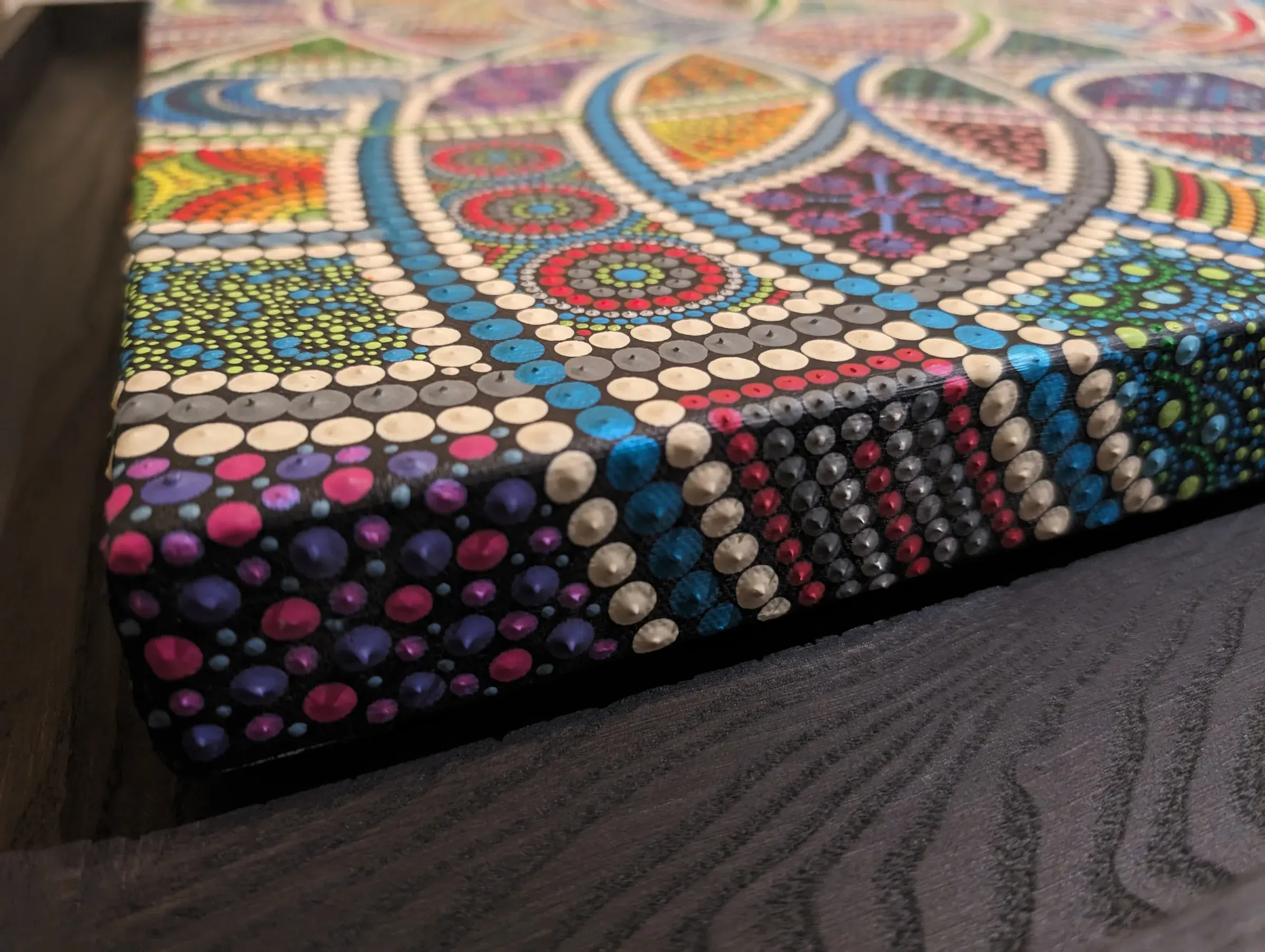
The surface is never flat. It breathes.
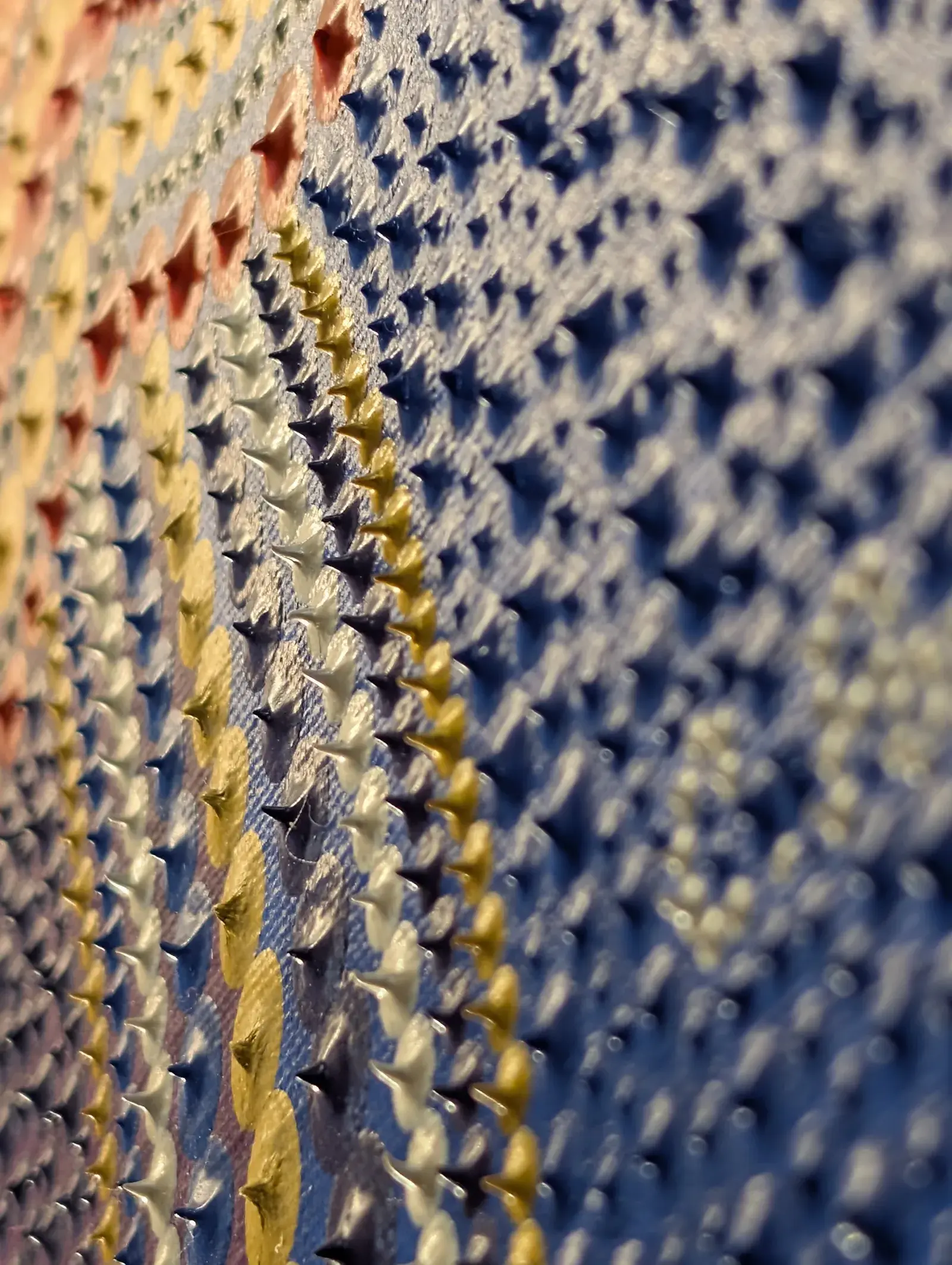
Detail · Acrylic on canvas
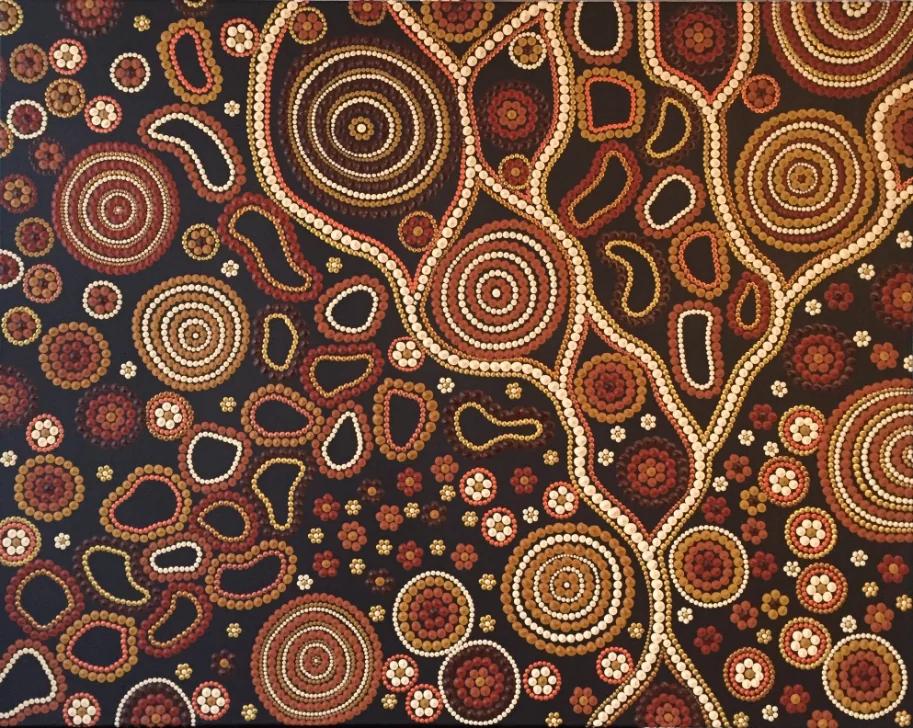
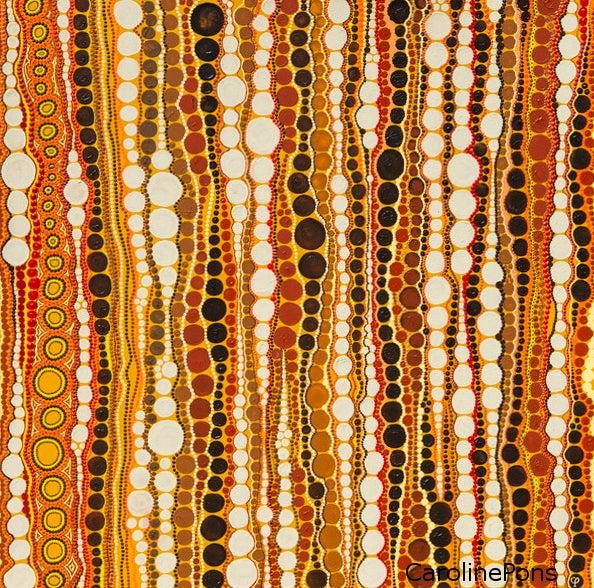
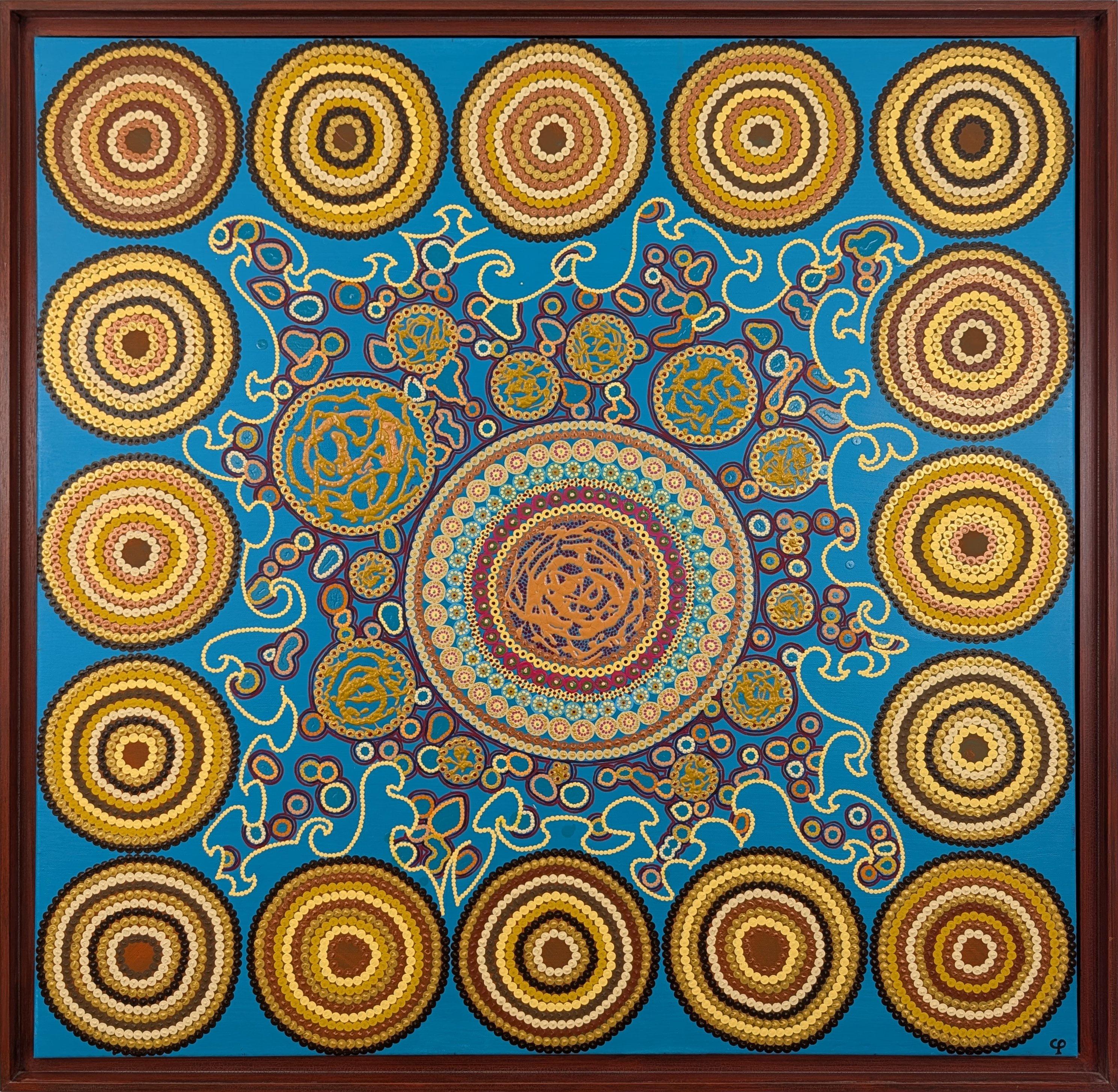
In Caroline Pons' universe, each dot pulses like the beat of a wing, a wave in the matter. Before her works, the eye travels slowly, captured by the colorful cadence of a tactile language. Like seeds sown on a skin stretched with light, the pearls of paint trace a living territory, in expansion.
The surface is never flat: it breathes. It undulates, vibrates, catches the light and invites you to explore it with the tips of your eyes. This organic, vibrant pointillism evokes a world in perpetual formation — a visual song where matter and spirit weave together a sensory geography.
II
Meditation through Gesture
Technique
The essence of the dot
Creation for Caroline Pons is above all an act of presence. Each dot placed on the canvas is inscribed in a rhythm, a concentration, a breath. For this, she uses a tool inspired by the mandala technique: a rigid tip, often rounded, which allows her to deposit paint in regular drops.
This method, which demands patience and precision, creates a relief and texture effect unique to her universe. The gesture is slow, meditative, almost ritual. The dot is never placed at random: it responds to an inner vibration, to an intuitive but rigorous compositional dynamic. This technique gives each work a respiratory rhythm, a visible pulse that captures light as much as attention.
If her inspiration finds its roots in Aboriginal aesthetics, the artist affirms a contemporary approach, free from any imitation. The gesture, the matter and the color become the vectors of a personal language, traversed by reminiscences, intuitions and silences.
Poetics of the dot — between cultural heritage and contemporary abstraction
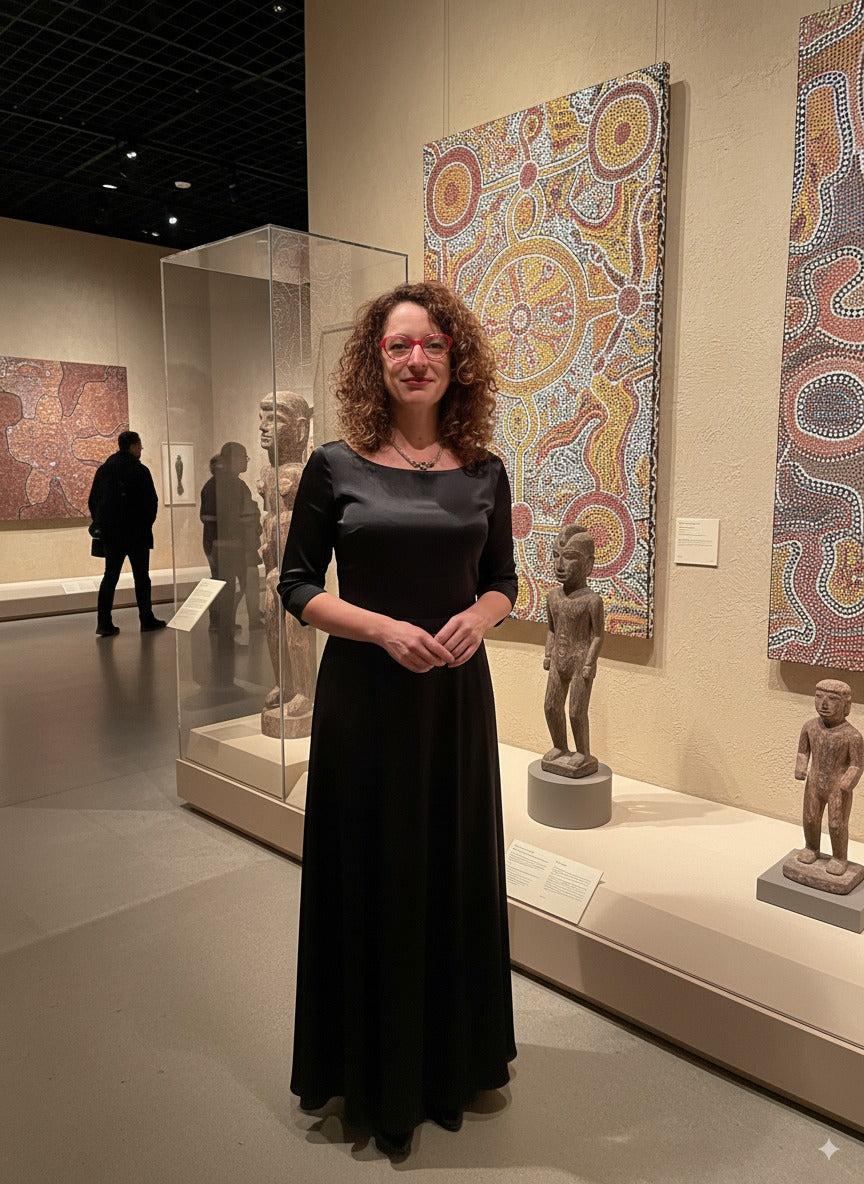
Caroline Pons, a passionate self-taught artist, discovers Aboriginal art during her first visit to the Quai Branly Museum. This aesthetic encounter acts as a revelation. Touched by the symbolic depth of the dot, she begins to create for herself, on the margins of any artistic ambition. What was merely a hobby gradually transforms into a singular, personal practice, where her own emotions, sensitivity and style take shape.
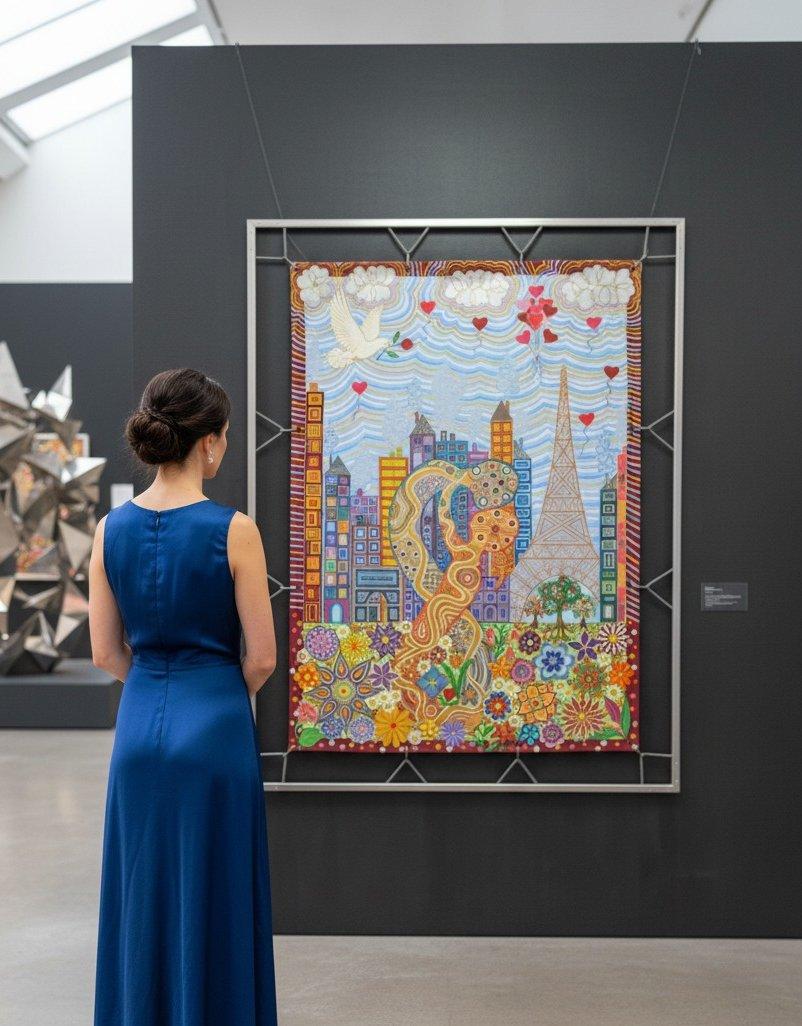
Living in Saint-Flour, France, Caroline is now engaged in a visual research at the crossroads of visual anthropology and abstraction. Her work draws on an aesthetic of the dot borrowed from Australian Aboriginal pointillism, without ever slipping into cultural appropriation. The dot becomes an autonomous vector of expression, carrying an open semantics around perception, memory and rhythm.
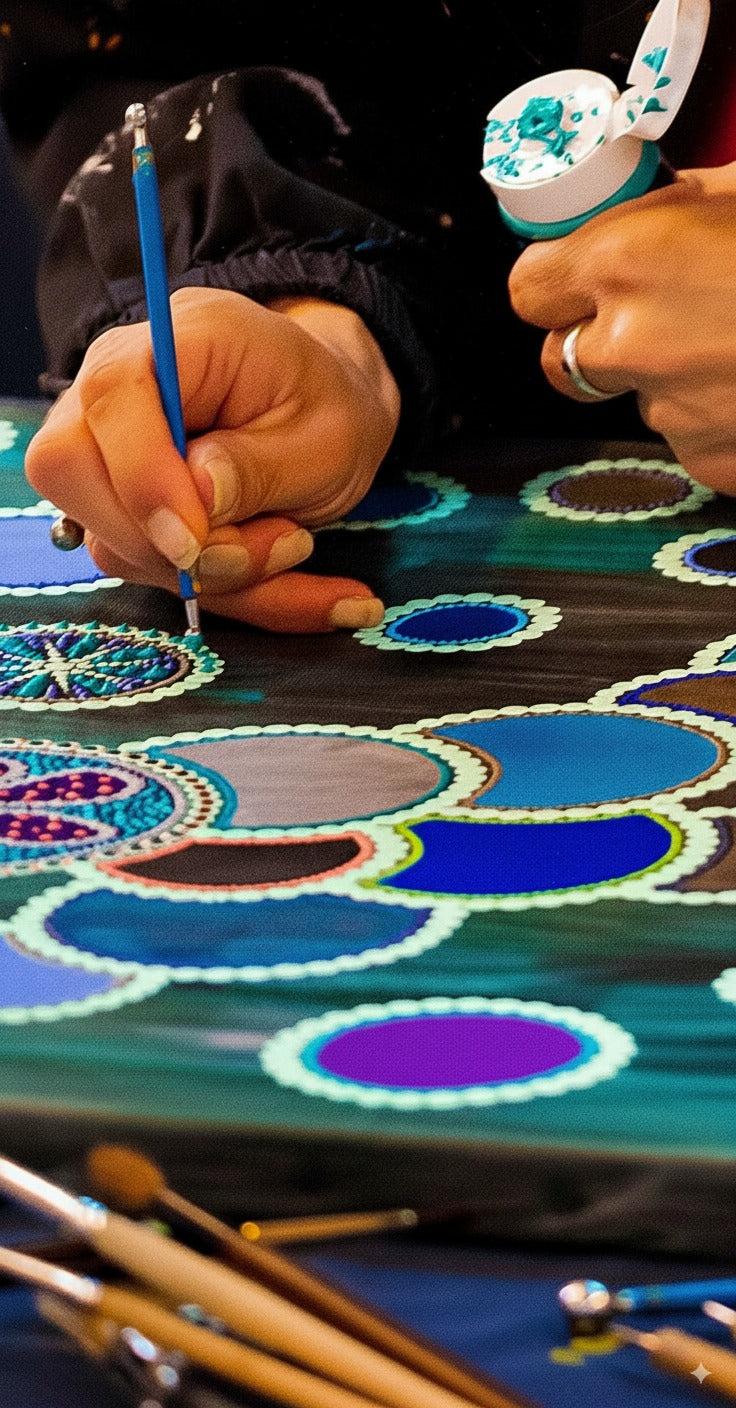
In a resolutely contemporary perspective, her work questions repetition as a meditative act and as a process of structuring the sensible. Her practice engages a dialogue between the codes of first art and those of Western non-figurative art, bringing into tension the notions of territory, trace and inhabiting the world.
Selection
Featured works
III
Through the years, through the gesture
Aboriginal Dream
80 × 80 cm · 2008Aboriginal Dream
80 × 80 cm · 2008Caroline Pons began her first exhibition efforts in March 2011, driven by enthusiastic, semi-professional energy, on the occasion of a group exhibition at the Cultural Center of Metz. Very quickly, her works intrigue, captivate, move: Songe aborigène earns her a first prize, Crazy a second, and the local press is enthusiastic about this newcomer to the pictorial scene.
D'après · AfterRoslyn Ann Kemp · Three Rivers Dreaming
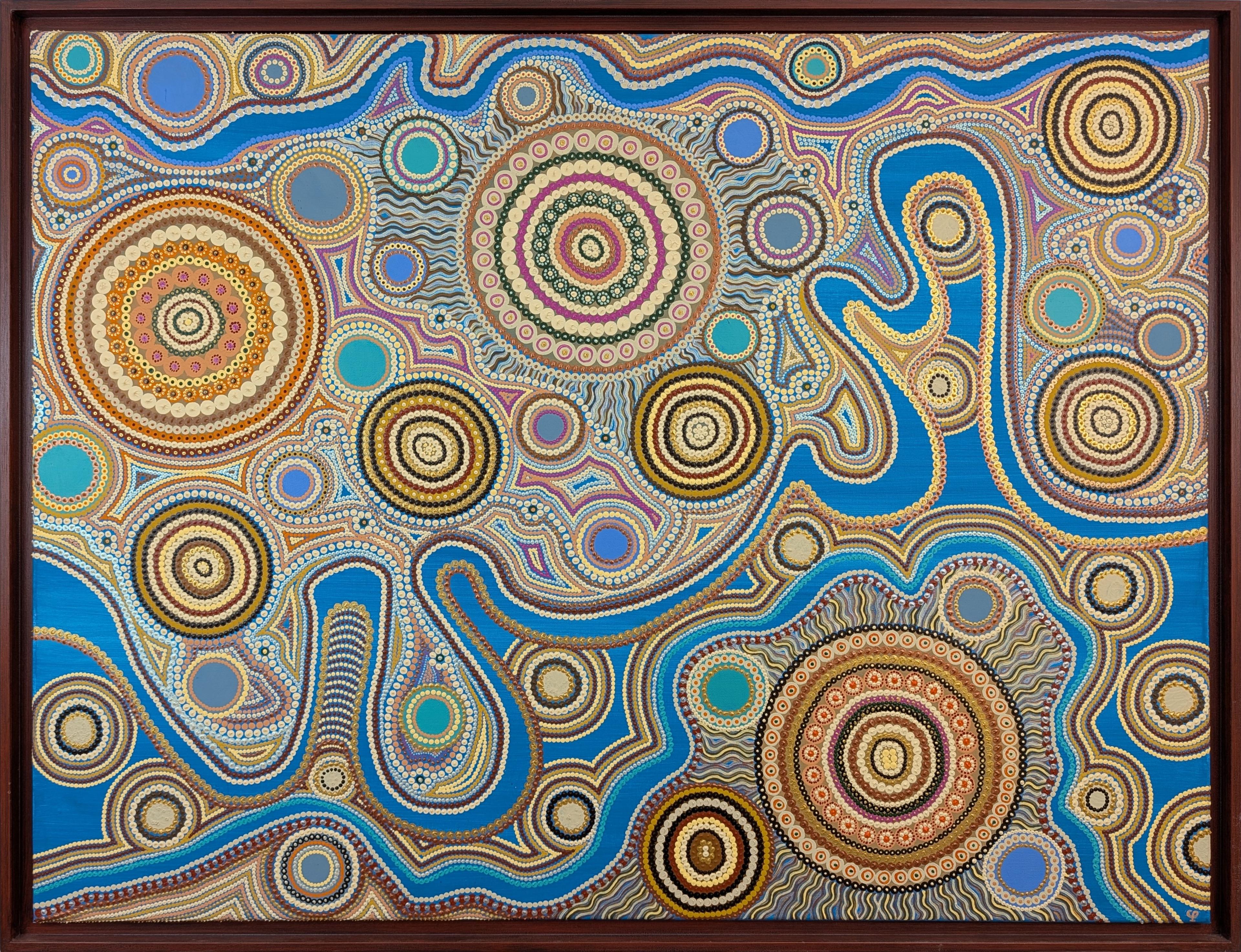
Reflections on Three Rivers Dreaming
116 × 89 cm · Acrylic on canvas · 2011
Long held privately
At the roots of her practice, Caroline wanted to give thanks — and to learn. Reflections on Three Rivers Dreaming, painted in 2011 at an imposing scale (116 × 89 cm), is a respectful revisitation of a major work by Roslyn Ann Kemp. The gesture here is unusually precise, each dot exact, the composition ample. It is a technical milestone: mastery asserts itself, yet the student steps aside before the master. Caroline kept this canvas private for many years, troubled by the feeling of having copied rather than created. Looking back, this silent dialogue with Aboriginal culture appears for what it is — an act of humility, and one of the most accomplished moments of her art.
The large-format challenge
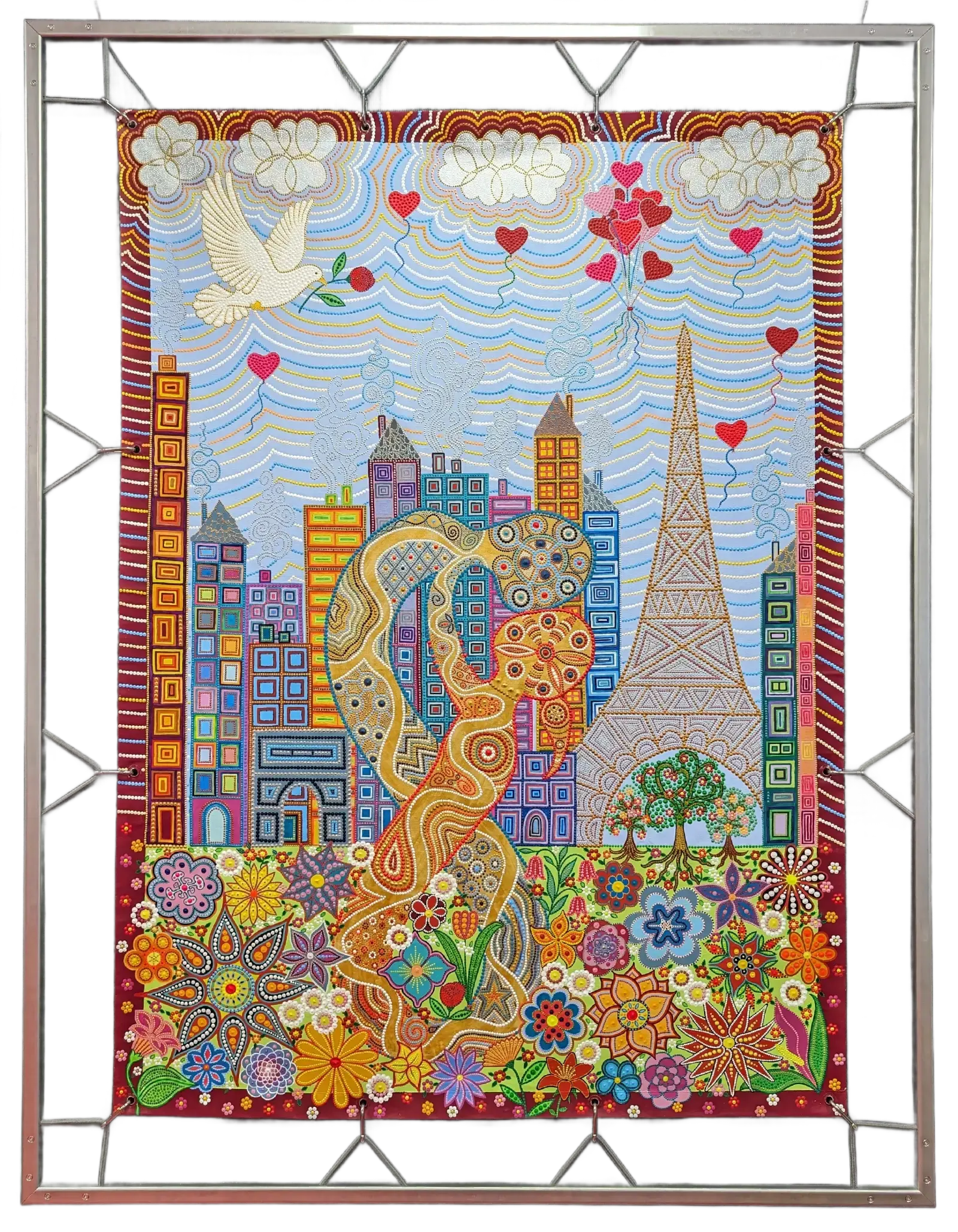
Quel Amour !
- Competition
- Grand Prix de Peinture · Istres
- Support
- Loose canvas, unstretched
- Mounting
- Metal frame
110 × 150 cm · Acrylic · 2018
In 2018, on the occasion of the Grand Prix de Peinture de la Ville d'Istres, Caroline took on what remains her most imposing canvas — Quel Amour !, 110 × 150 cm. The support is unusual: a loose canvas, without a stretcher, mounted instead on a metal frame, leaving the surface free to breathe slightly. At this scale, the dot technique becomes a challenge — holding the same precision across every square centimetre. The work is monumental in size and astonishing in its finesse: a technical peak in the artist's journey.
A feminine triptych
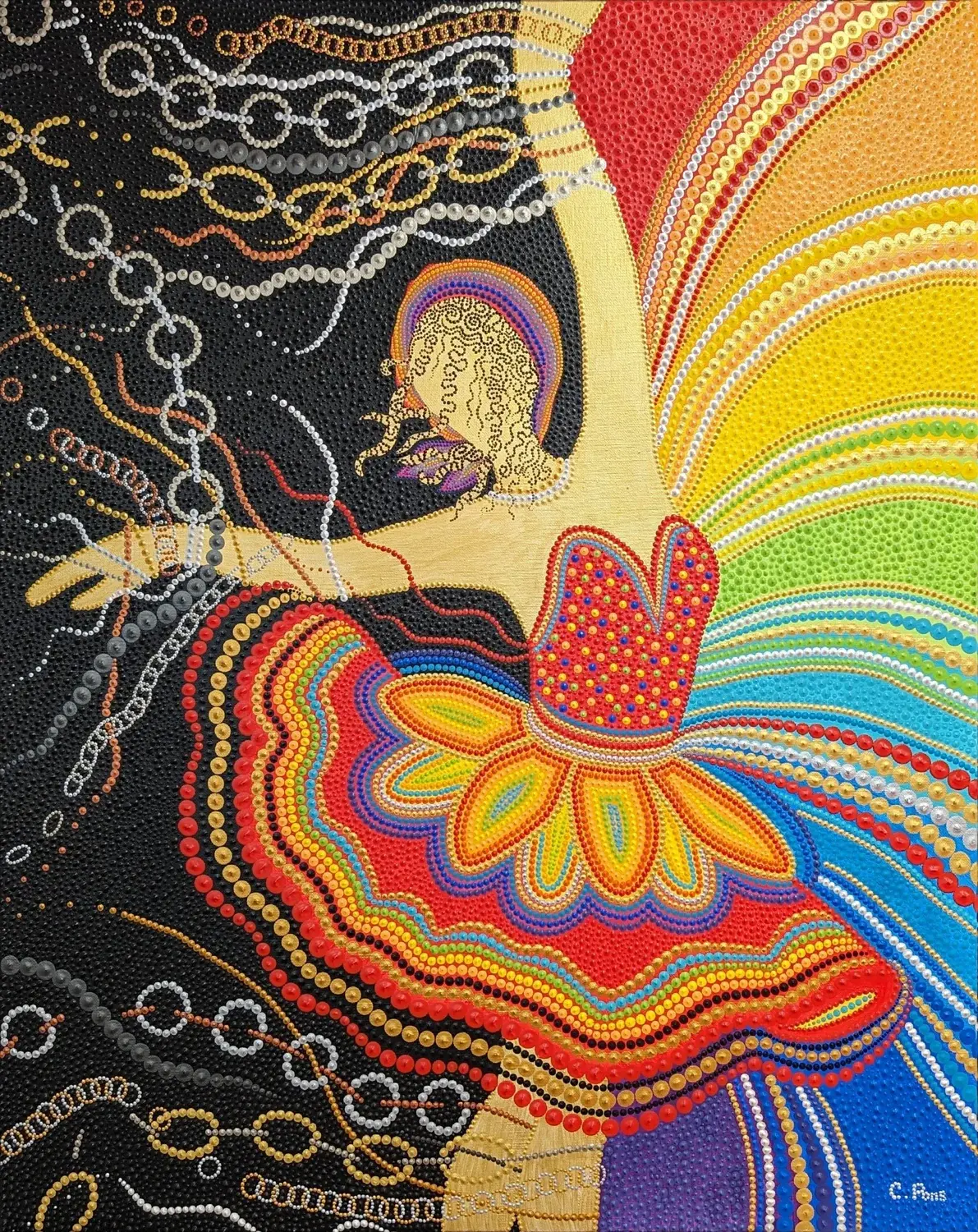
Femme Mystère, Femme de Lumière
- Venue
- Chapelle · Istres
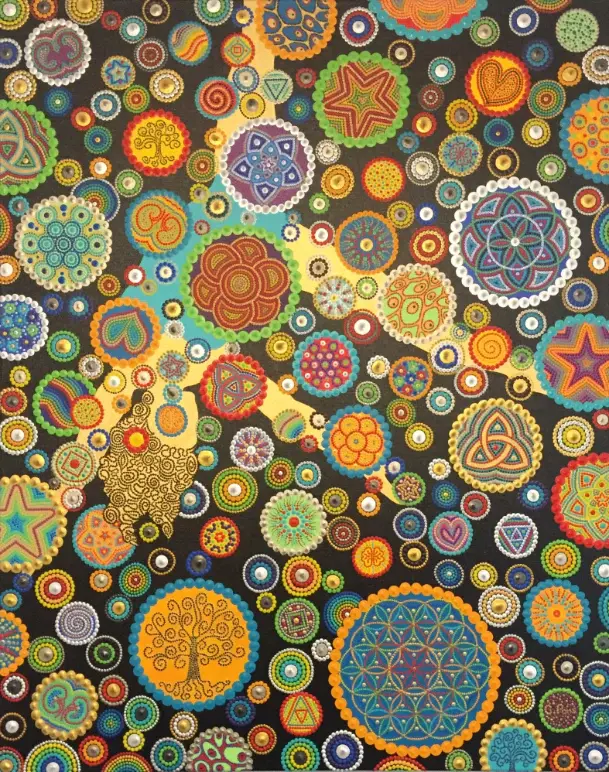
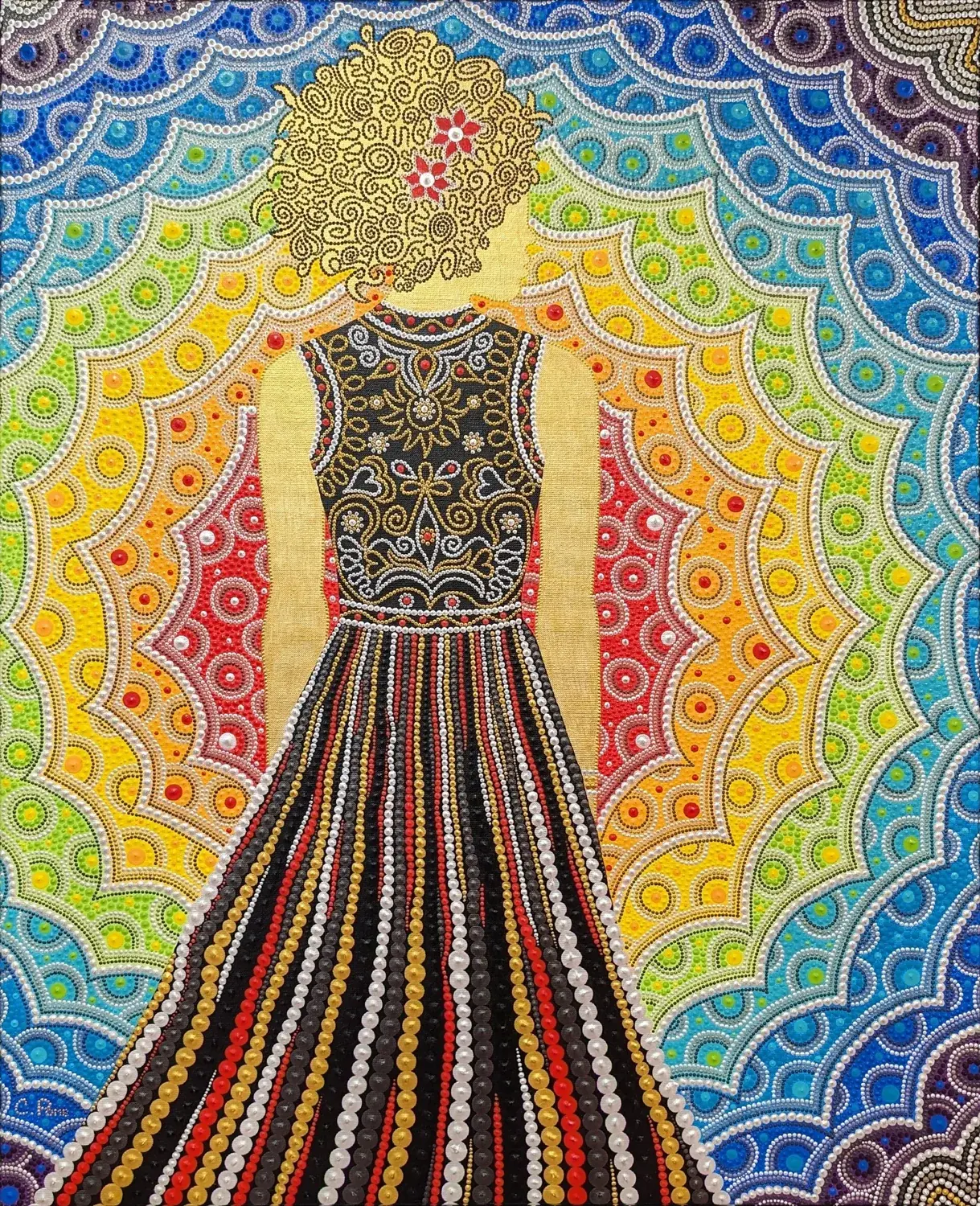
Triptych · 73 × 92 cm each · 2019
In January 2019, Caroline joined four other artists at La Chapelle in Istres for the Rencontres C2L'art collective exhibition "La femme mystère, femme de lumière" — curator Sylvie Cruzel Vilette had spotted her the previous year at the city's Grand Prix de Peinture. Caroline presented her first triptych: three canvases of 73 × 92 cm — En apesanteur, Sérénité, Libération — exploring femininity as a cycle. In her own words: "I wanted to show the dark side of women, while underscoring the importance of the light each one gives off." Here pointillism turns liturgical, set within a contemplative space — three movements, three lights, one same quest: to shed gravity, to find stillness, to dare release. A milestone, not by scale but by ambition.
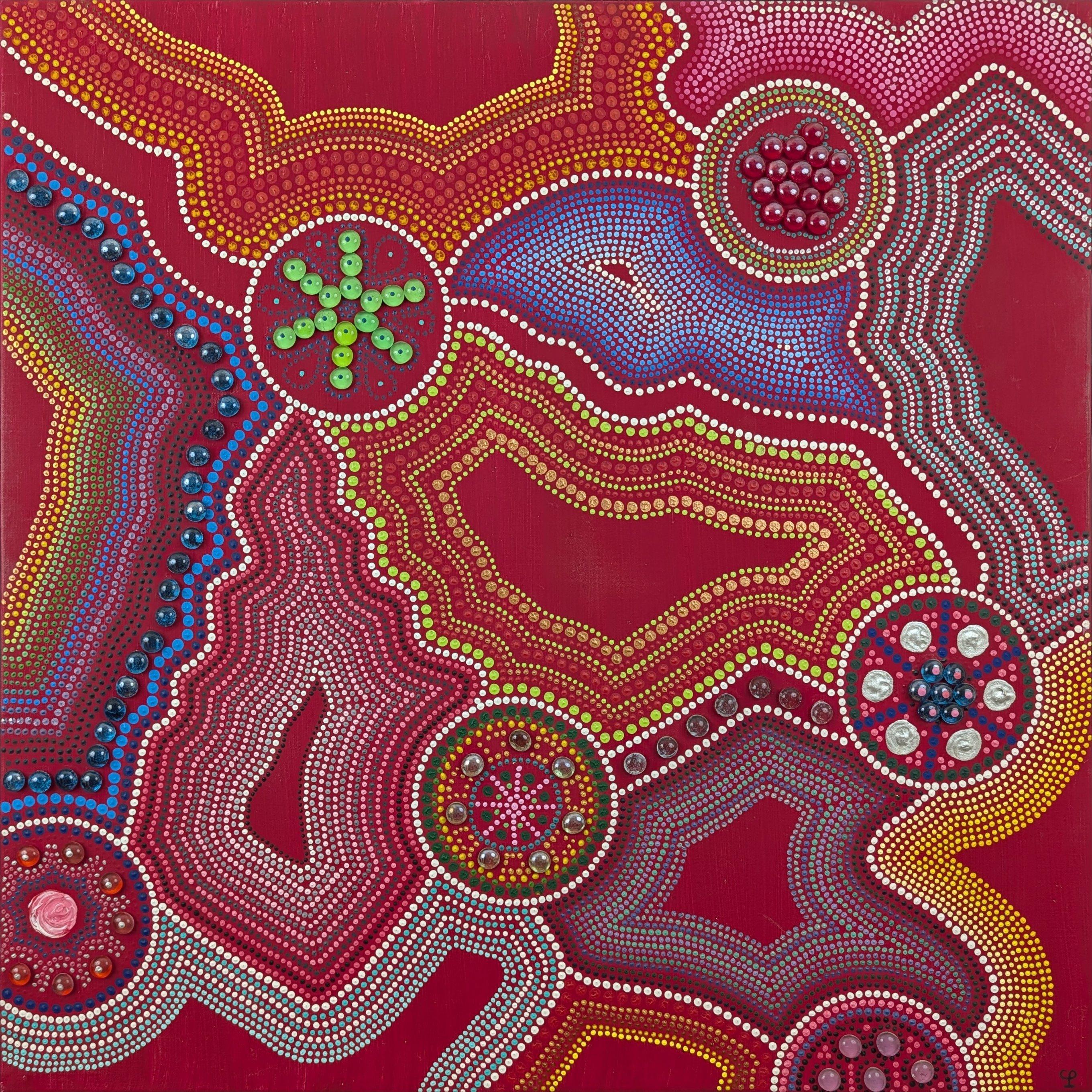
Garden of Vibrations
80 × 80 cm · 2022
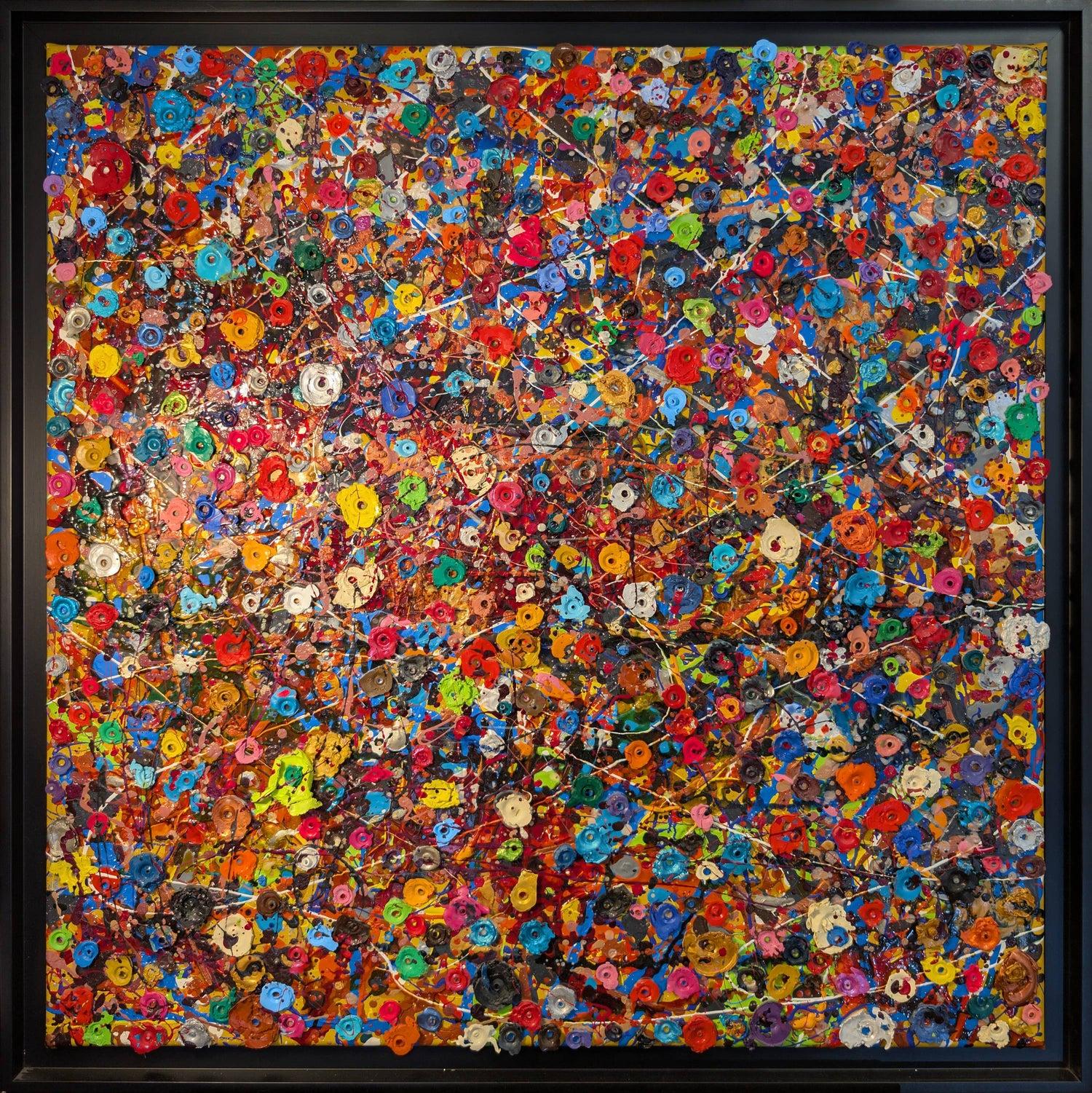
Fourteen years after Songe aborigène, the gesture has nothing left to prove. Jardin des vibrations is not a scene: it is an energy. A breath of colour sweeps across the 80 cm square like a rain of blossoms — the reds sing, the blues murmur, the yellows splash. Nothing is fixed: everything pulses, dances, surges in a perfectly living disorder. After the precision of the homage, the trial of the large format and the ambition of the triptych, Caroline no longer composes: she lets things happen. A garden without fence or season, where forms invent themselves as you contemplate them.
Fractal City
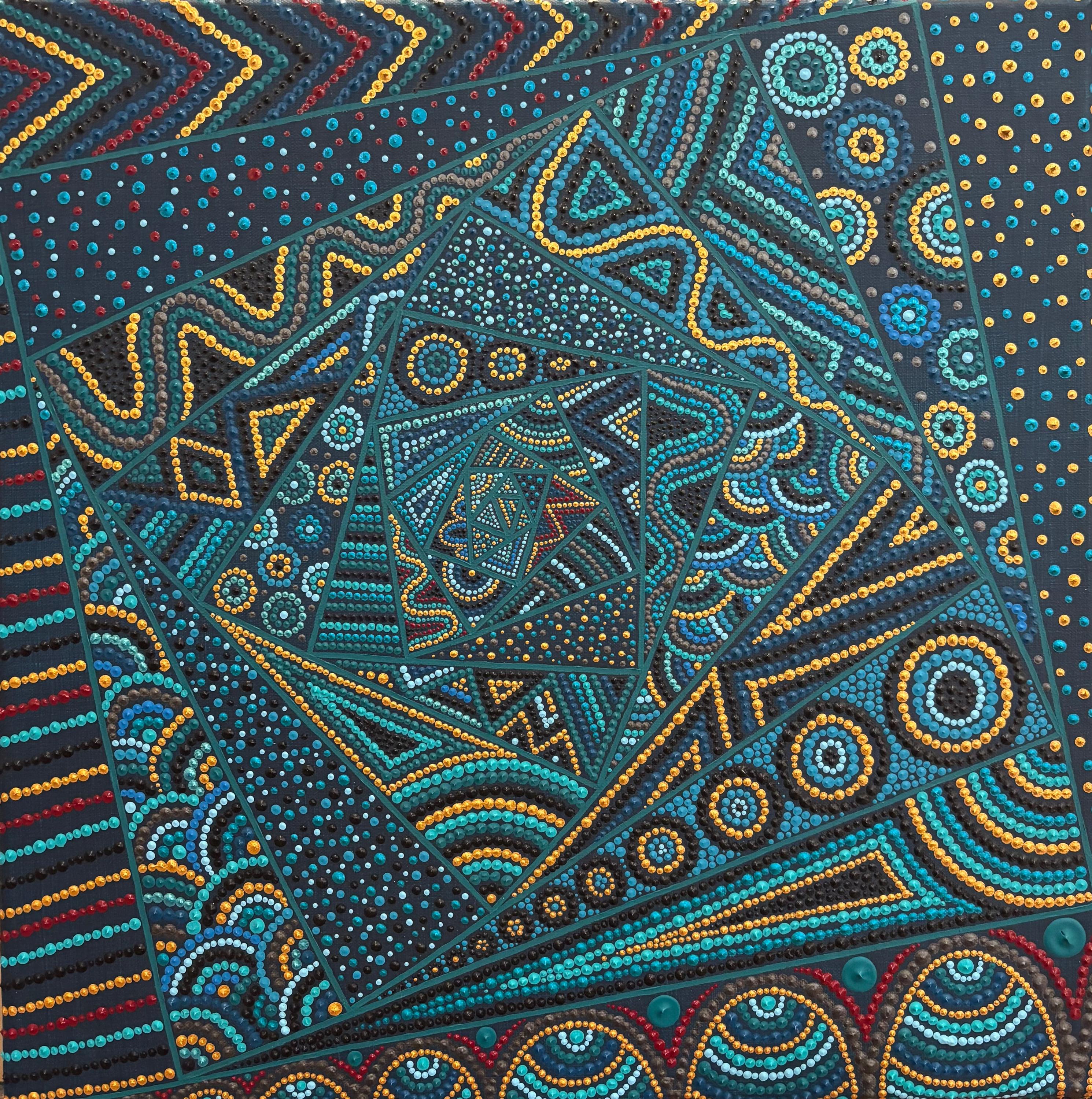
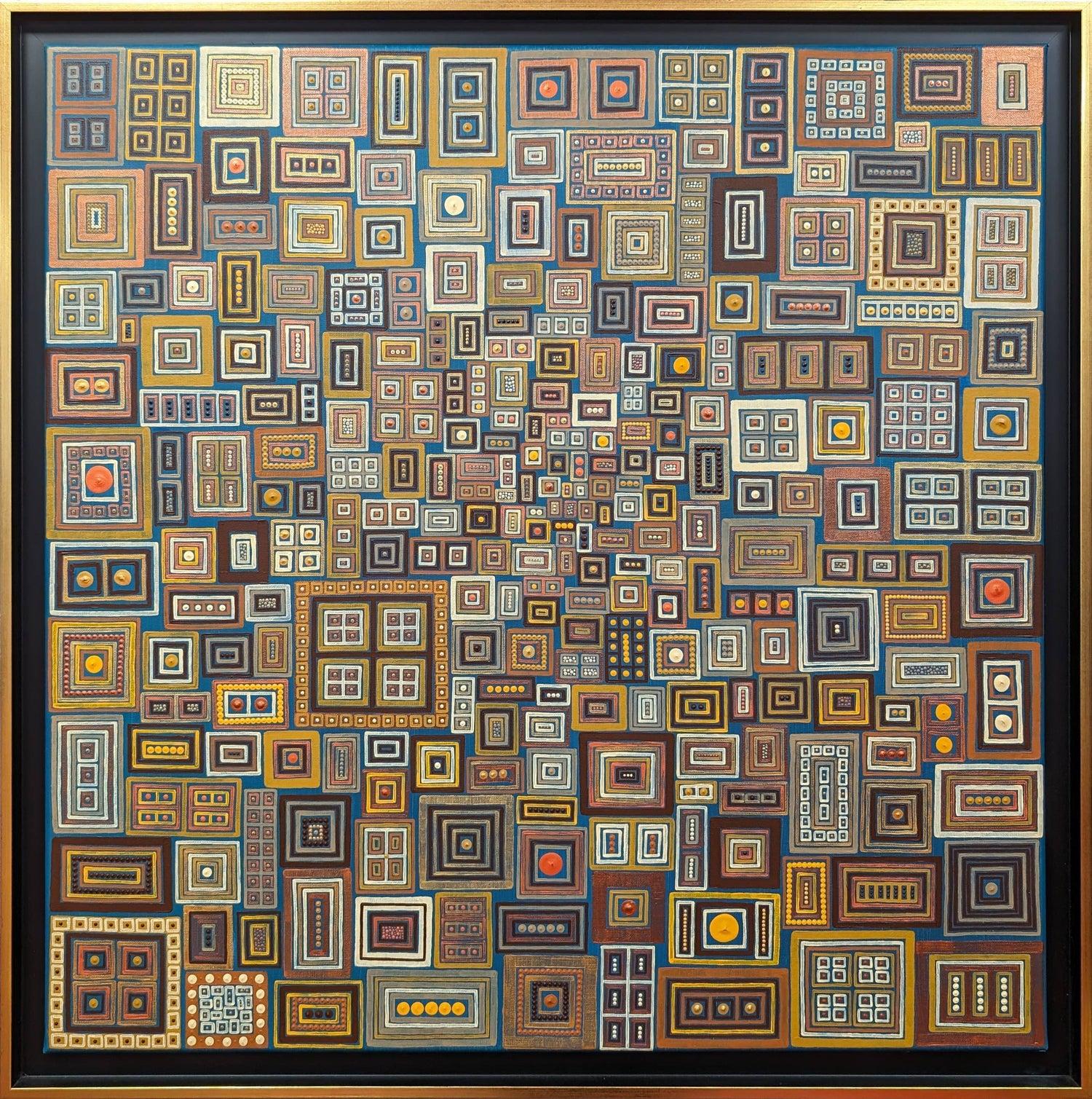
That same year, the dot changes scale and becomes architecture. Ville fractale nests squares within rectangles like the cells of an imaginary city — invisible alleyways, hidden squares, mathematical structures that only poetry can inhabit. The infinitely small converses with the immense; the eye loses its way, then finds it again, guided by pulses of ochre, dense blue and aged gold. Over the years, the gesture became a language; through the gesture, the language became a territory. And the cartography of the living goes on being drawn, dot after dot.
80 × 80 cm · 2022
The artist
Caroline Pons
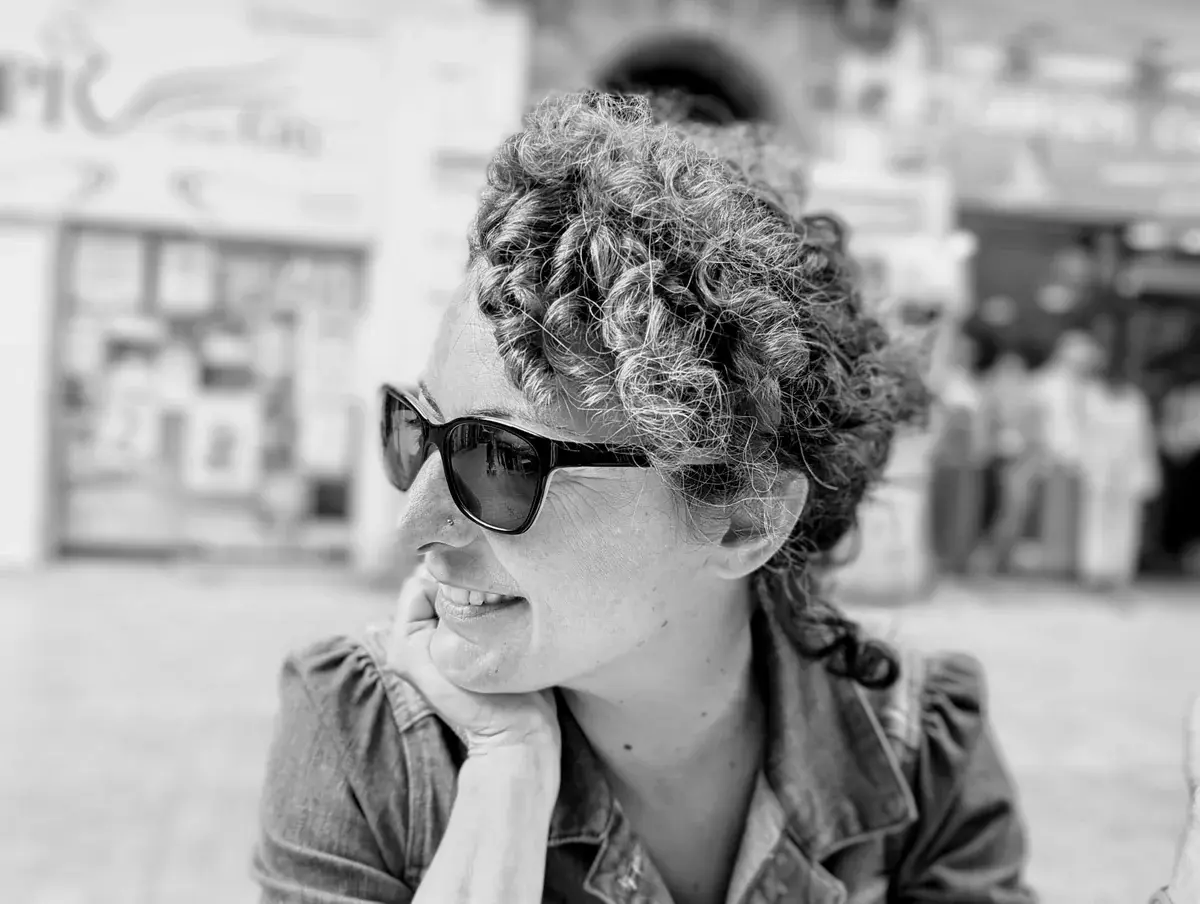
I'm Caroline Pons. Painting, for me, is a way of breathing — of entering into dialogue with the world and sharing what stirs in me. I want each canvas to become a place of encounter, where the viewer can project their own dreams, memories, and inner colours.
The studio
Visit the studio
Saint-Flour, Cantal, France. A place of slow gesture and living matter, where each canvas is born from a patient dialogue with the light. La Maison de Caro welcomes visitors by appointment.